Amex black card images and designs
Updated · By Larpea
The Amex Black Card is officially the Centurion Card, an invitation-only American Express card introduced in 1999. In most countries it is anodized titanium, laser-etched and accented with stainless steel, according to Wikipedia. For videos, use an original black card with no network logo, a hidden number and a mockup label.
What the real Amex black card is
Black cards are a staple of our card wallet mockups directory, so here is the real card first. The card people call the Amex Black Card is the Centurion Card, an American Express card introduced in 1999, which Wikipedia says has only been issued to clients invited by the company. According to the same page, in most countries it is anodized titanium, with laser-etched information and numbers, accented with stainless steel, and in some places a plastic EMV chip card instead. That is why the pictures people search for show a dark, brushed metal slab with engraved text.
Not affiliated with American Express or Amex. We use no logo, card artwork or trademark of either, and the card shown below is our own. For another card look, see Revolut card designs.
The real card and a video card, side by side
Checked on .
| Point | The real card | A card for your video |
|---|---|---|
| Name and maker | The Centurion Card, nicknamed the Black Card, issued by American Express. Wikipedia | An original issuer name you invent: an issuer name is one field in the My Larp Cards designer. |
| Launched | 1999. Wikipedia | Not applicable. |
| Who can have one | Only clients invited by American Express to apply, per Wikipedia. | Anyone can film a mockup, which is why it must be labelled as one. |
| Material | In most countries anodized titanium with laser-etched information and numbers, accented with stainless steel; plastic with an EMV chip in some places, such as Israel. | Our “Black metal”, “Carbon” and “Brushed titanium” finishes are pictures of finishes, not a metal card. |
| Network and number | A real card number and network marks. | No number works, there is no card-network logo, and nothing is charged when you tap. |
The last column is the point of this guide. A video about a black card does not need the real card or its name, and a viewer cannot tell an original from the real thing on screen. That is the reason to label it.
How a black card reads on camera
A dark metal card is the hardest finish to film, because it is black, reflective and small in the frame at once. These are our own filming notes, and they apply to the real card and to a mockup alike.
- Side light, not front light. Light from one side shows the edge and the brushed grain; front light turns the card into a black rectangle.
- Match the background to the card. On a dark app, a black card disappears; give it a lighter surface behind it.
- Keep the camera angle low and steady. Metal reflections move as you do; a tripod removes the flicker.
- Show no number. Only invented last four digits, or none. A readable number is never needed in a video.
- Check the result on a phone screen. A card that looks fine on a monitor can vanish at phone size, so judge it at the size viewers will see.
Three honest ways to put a black card in a video
A labelled skit. A character takes out a black card, and the frame says “skit” or “mockup”. The card is a prop, and the joke is the character, not the card. It works best when the issuer name is invented and obviously so.
An app or product demo. A fintech concept, a wallet design or an interface test needs a convincing card on screen. A mockup card with invented details does the job, and app mockups for ads and demo videos covers the rest of the setup.
A filming tutorial. A video about how to light a metal card needs only an object that looks like one. You can teach side light and angle on any dark card, without showing anyone’s real details.
What none of the three does is claim the status. Showing a black card to suggest you have been invited to hold the real one, in order to sell something or to be believed, is the reliance problem that this site’s detection guides describe. A prop is fine; a claim is a different matter.
An original black card for your video
My Larp Cards (card wallet simulator). Every card is a mockup. It has no number you could pay with, is linked to no bank and no card network, and charges nothing when you tap it. Among its original designs are “Black metal”, “Carbon” and “Brushed titanium”, and its designer lets you pick a finish, name the issuer and set the last four digits. The card stack in the image below includes a black card from an invented issuer, with no network logo.
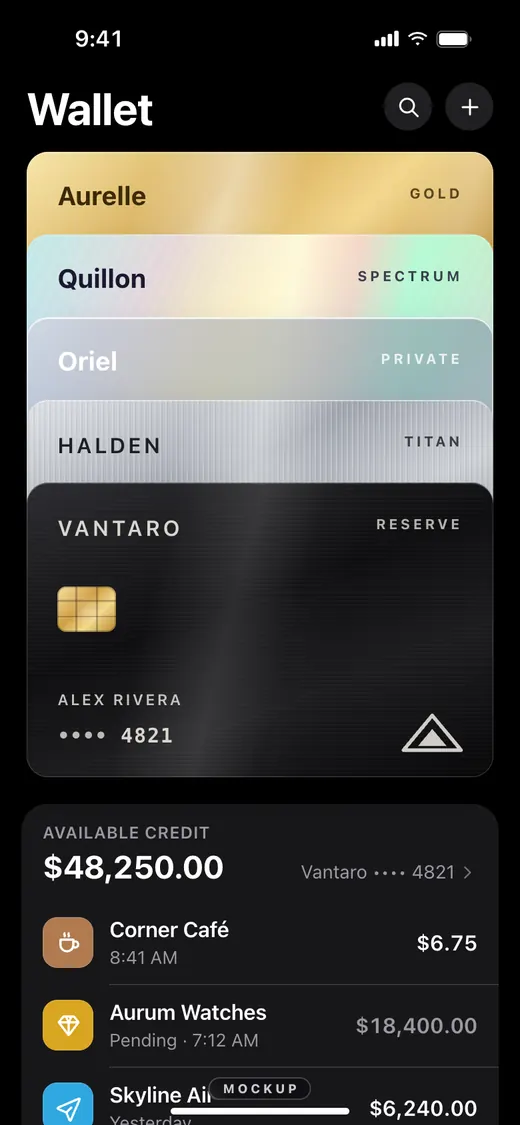
A card on screen is a prop. It is not proof of wealth and should never be used to get money, credit or trust from anyone; why people pretend to be rich and rented flex photos show where that goes wrong. For bank-app screens, see the bank app mockup guide, and for the wording that says it is a mockup, mockup labels.