How to tell if a hardware wallet is fake: 9 checks
Updated · By Larpea
You tell a hardware wallet is fake by where it came from and how it starts. Buy from the maker or a listed reseller, and refuse any device that arrives set up or with a pre-written recovery phrase. A genuine device generates your words itself and you never type them into anything else. Nine checks follow.
How to tell in 60 seconds. Buy from the maker, generate your own recovery phrase on the device, and never type it anywhere else. The full method sits in how to spot a larp.
What the scam looks like
A counterfeit or tampered hardware wallet exists to learn your recovery phrase. It is sold through marketplaces and ads, or arrives with a pre-printed card that tells you not to bother generating your own words. The device then looks like a real one and works, until you put funds on it. The same phrase that the seller wrote can restore the wallet on another device. Crypto thefts like this are reported to the services in the table at the end of this page. A related scam works at the software level: the crypto drainer is a site that asks you to sign away your tokens.
Nine checks before you use a hardware wallet
- Buy from the maker, or a reseller the maker lists. Why it matters: The maker's own site names its authorised sellers. Look-alike listings on marketplaces and in ads are where counterfeit and tampered devices are sold, often at a small discount.
- Refuse any pre-written recovery phrase. Why it matters: A card or booklet that arrives already filled in with words is the scam. Whoever wrote the phrase can empty the wallet the moment you add funds. A device must generate your phrase in front of you.
- The device must arrive unconfigured. Why it matters: A new device asks you to set it up. One that arrives already set up, or asks you to enter an existing phrase to "activate" it, has been touched by someone else.
- Inspect the packaging and seals. Why it matters: Compare the box, the seals and the tamper-evident parts with the maker's own pictures and instructions. Damaged or re-glued seals mean you stop and contact the maker.
- Use the maker's authenticity check, if there is one. Why it matters: Several makers let their own software confirm that a device is genuine on first connection. If the check fails or cannot run, do not use the device.
- Get the software from the right place only. Why it matters: Type the maker's address yourself or follow the link from its own site, then check the publisher name in the store. Malwarebytes reported in July 2026 a lawsuit by three users against Apple, who say a fake crypto wallet app on its App Store took about $1.8 million from them, so a listing is not a guarantee.
- Never type your recovery phrase into a computer, a phone or a website. Why it matters: A genuine device shows you the words on its own screen and asks you to write them down. If anything else asks for them, whoever wrote that page now has your money.
- Verify the address on the device screen. Why it matters: Before a first real deposit, check that the address displayed by the device is the same as the one your software shows, and send a small test amount first.
- Be wary of urgent updates and support chats. Why it matters: Messages that say your device is at risk and you must act now, or "support" who contact you first, are the usual cover for stealing a phrase. Update only through the maker's own software.
What our simulator does, and does not do
Flexdger Wallet is a simulation of a hardware wallet that we designed for film and video. By its own description: “A simulation of a hardware wallet, of our own design. It stores no keys, holds no coins, connects to no blockchain and never asks for a seed phrase.” That is the opposite of a real device: it has no function you could rely on for money. If you see a page offering an app called a wallet that does ask for a phrase, it is not ours. For the explanation of why simulators exist, My Larp Wallet has a hardware wallet simulator explainer and a guide to fake crypto wallet apps.
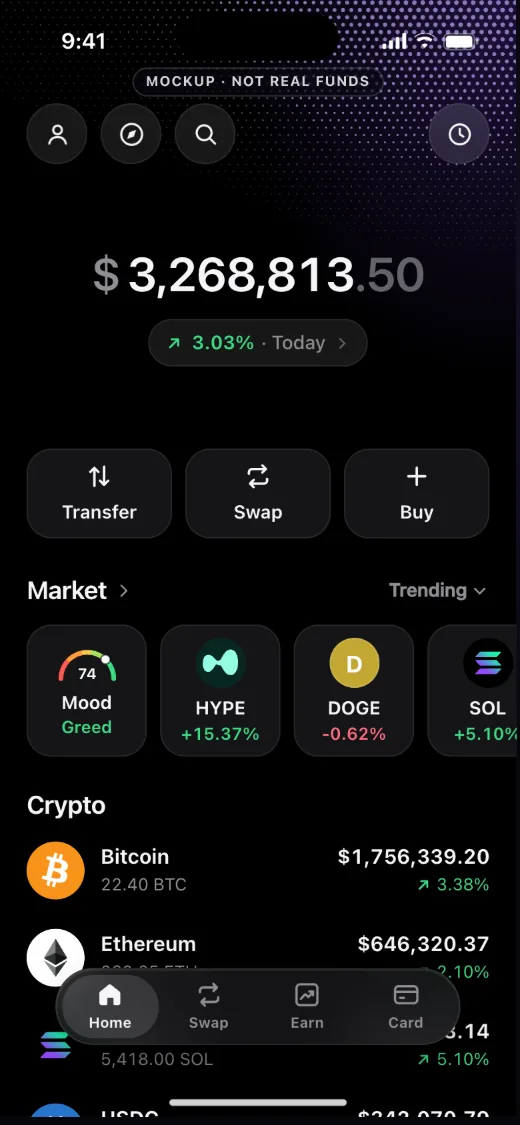
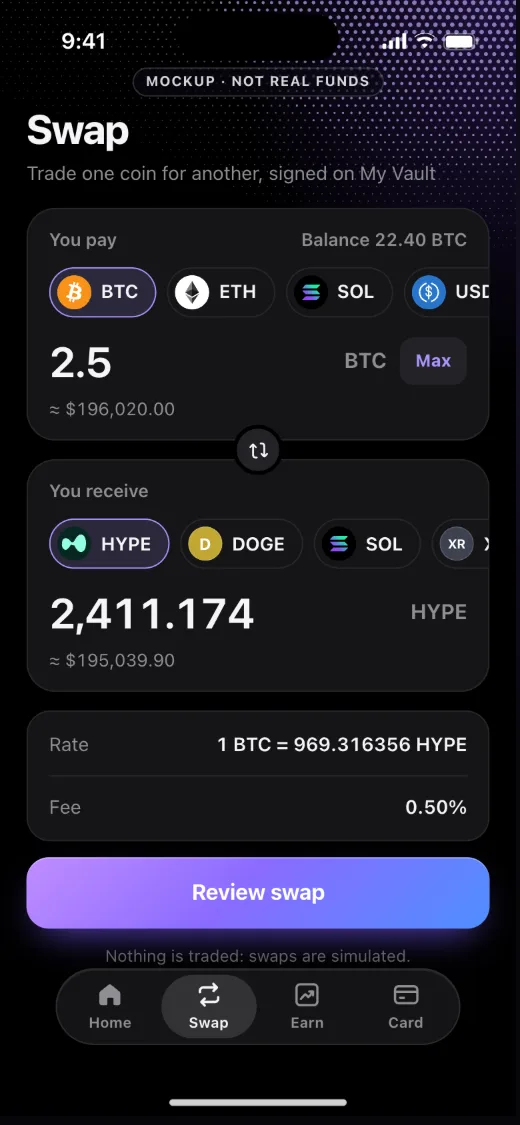
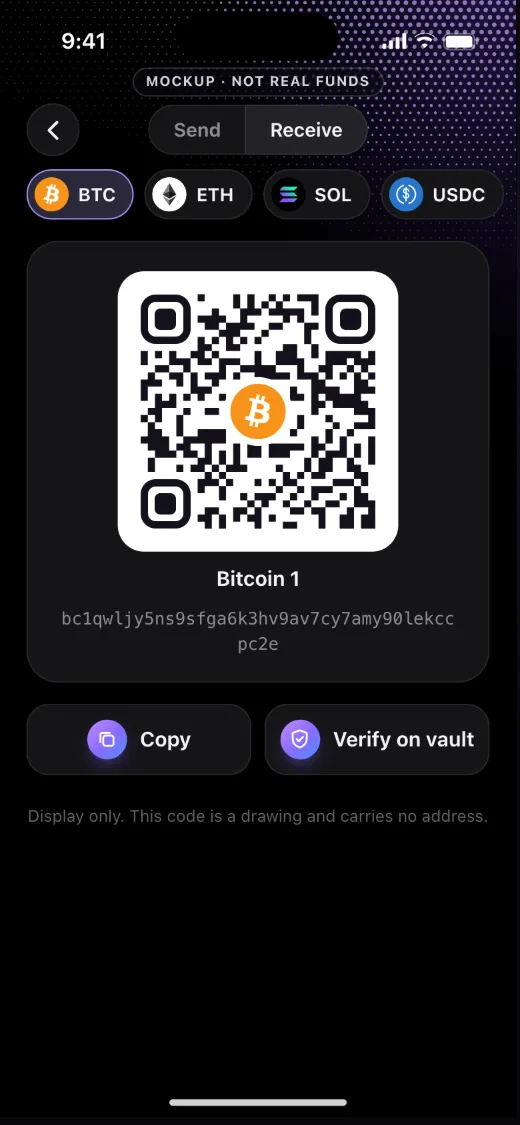
Read the small print on those screens: a label on top that says the funds are not real, a swap that says nothing is traded, a receive screen that says the code carries no address. A real device never needs that reassurance, and a counterfeit never gives it.
What to ask for instead
If someone is selling or gifting you a device, ask for the maker's order number and the authorised-reseller listing, and verify both on the maker's own site. If you are offered a "pre-initialised" device, the answer is no. If the seller will not let you set the device up yourself, the answer is no.
If you are the one asked for proof
No honest request for a hardware wallet ever includes your recovery phrase. If someone asks for it to "prove" you own funds or to "recover" a wallet, stop. Proof that you control an address is a message signed with it, which never reveals the phrase. For props in a video, use a simulator, clearly labelled, and read larp app safety. The law on showing balances you do not have is in the US law guide.
If you have been scammed
If you typed a phrase from a card you did not generate, treat the wallet as compromised. On a clean device, set up a new wallet and move what remains at once. Revoke token approvals on the old address, run a malware scan, change your passwords, and report it. A speedy report helps exchanges freeze funds.
| Country | Where to report | What it takes | Confirmed on |
|---|---|---|---|
| United States | ReportFraud.ftc.gov (Federal Trade Commission) | Scams and fraud of any kind. | |
| United States | IC3 (FBI Internet Crime Complaint Center) | Cyber-enabled crime, including crypto theft. | |
| United Kingdom | Report Fraud (City of London Police) | England, Wales, Northern Ireland; Scotland: call 101. | |
| Canada | Canadian Anti-Fraud Centre, online reporting system | Online, anonymously if you wish; also tell local police. | |
| Australia | Scamwatch (National Anti-Scam Centre, ACCC) | Scams reported by the public; it does not recover money. | |
| Australia | ReportCyber (Australian Signals Directorate) | Cybercrime and hacked accounts. | |
| India | National Cyber Crime Reporting Portal and helpline 1930 | Call 1930 fast, with the transaction ID, then file online. | |
| France | Cybermalveillance.gouv.fr (17Cyber) | Diagnosis and guided help after an online scam. | |
| Spain | INCIBE helpline 017 | Free advice daily; a formal complaint goes to the police. |